How Envision Is Building Safer Winter Travel Through Rehabilitation Services
By Envision Marketing • Jan 21, 2026
Blog Content
Winter changes how people interpret their environment.
Snow alters sound. Wind disrupts traffic patterns. Ice removes familiar edges underfoot. For people traveling with a white cane, these shifts do not simply make movement more difficult. They change the reliability of the information used to make safe travel decisions. That is why orientation and mobility training sits at the core of Envision’s Rehabilitation services.
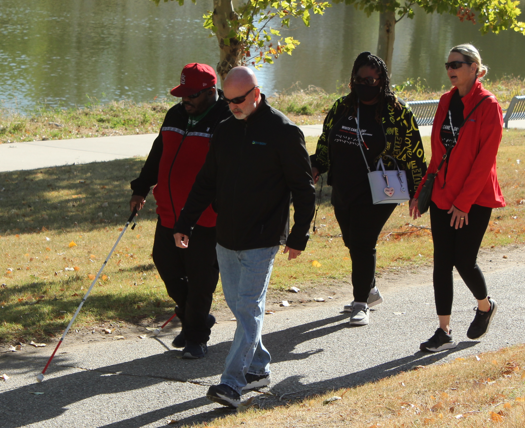
White cane training is grounded in strategy, not shortcuts. When sound becomes unreliable, Envision Orientation and Mobility Specialists (O&M) teach travelers to actively collect information by turning the head to gather accurate auditory cues before committing to a decision. Safe travel is not driven by speed, but by judgment. “Confidence comes from making informed decisions repeatedly, not from moving faster,” explains Ray Oddis, Envision O&M.
Winter conditions reinforce that approach. Snow and slush can hide curb edges and make slopes harder to detect, which means travelers rely more heavily on alignment and feedback from the white cane to stay oriented. At Envision, white cane users are taught pausing longer than normal in winter environments to re-orient is not hesitation, it is a trained safety response. When auditory cues are distorted, travelers are taught to use tactile warning surfaces and the physical push-button sign to establish direction and confirm position before moving forward. “When sound isn’t giving you clear information, touch becomes the way you confirm where you are and which direction you’re headed,” says Oddis.
Year round Envision recognizes the essential role white cane travel plays in human safety and independence. Through comprehensive orientation and mobility instruction, Envision supports the development of practical travel skills that prioritize safety, awareness, and informed decision-making. These services are offered at Envision Vision Rehabilitation Centers in both Wichita and Dallas, reinforcing Envision’s commitment to rehabilitation that supports safe, independent travel in real-world environments.