Empowering the Workforce: Envision’s Approach to Assistive Technology
By Envision Marketing • Nov 26, 2025
Blog Content
Have you ever wondered how someone who has vision loss unlocks their phone to read a text from a friend, finds the right bus in a crowded transit station, scans a menu to order lunch, clicks “Join Meeting” on a Zoom invite, or completes a multi-page online job application without ever seeing the screen?
For thousands of adults experiencing vision loss, these everyday moments, and especially the steps tied to finding and keeping a job, are made possible through tools like the JAWS screen reader, ZoomText magnifier, VoiceOver on iPhones, braille displays, navigation and identification apps, and emerging smart-glasses technology. All of these fall under the umbrella of assistive technology, otherwise known as “A.T.”, the essential tools that make communication, learning and the modern workplace accessible.
From a distance, A.T. can look effortless. A voice reads a webpage aloud. Text enlarges instantly. A phone becomes entirely audio-driven. Beneath that smooth surface, however, is a lot to learn. Screen readers require users to memorize dozens, sometimes hundreds, of keyboard commands just to complete the tasks most people do quickly. Navigating a document, opening a PDF, filling out a form, joining a virtual meeting or submitting an online application becomes a skill people learn step by step with practice. .
For many, it’s challenging. As one Envision program participant put it, “I used to be a computer geek, but the worse my eyes got, the more I got so insecure about it.” Learning the very tools that could help them compete in today’s job market can feel like another hurdle without support.The financial side is also a challenge, as software and devices can be expensive.
For a job seeker who is experiencing vision loss, the biggest obstacle often isn’t motivation or talent. It’s a website that won’t read, an online form that can’t be submitted with a screen reader, or a training system they can’t independently access. Instead, when someone understands how to use assistive technology, their independence grows. They can apply for jobs independently, respond to emails, complete onboarding paperwork, navigate a new building and take on roles that once felt out of reach. Technology becomes more than a tool; it becomes a path back to connection and work.No device, however, works without training, patience and support.
That is exactly where Envision steps in.
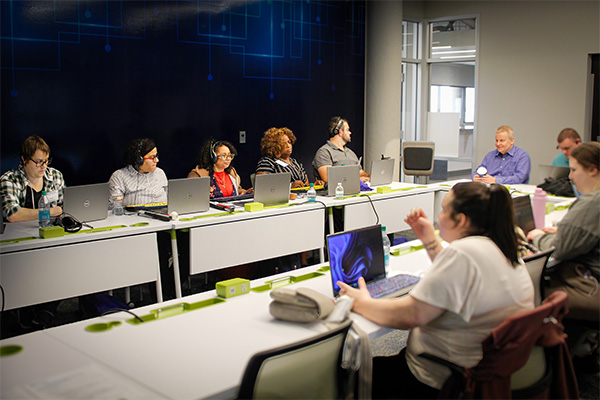
Through programs like the Workforce Readiness Bootcamp, adults receive the hands-on training that helps them learn and use technology confidently on the job. Participants practice JAWS, ZoomText, VoiceOver and workplace applications in a setting built for exploration rather than pressure. They log into systems, navigate forms, complete assignments and troubleshoot roadblocks in real time, guided by people who understand what learning A.T. actually requires for employment success.
For many, the change begins with confidence. “When I came here, it was really nice learning about apps that I didn’t even know existed,” one participant shared. Another said, “I’m a very isolated person, so it let me break out of my shell and be comfortable around people that were like me.” Others found themselves applying for roles they never believed were possible. “It helped me realize some things about myself that I didn’t know in the workforce area,” one participant said. “It prepared me to apply for jobs I didn’t think I could apply for.”
Envision’s assistive technology training programs encourage people to explore a variety of careers where communication and technology skills are valuable. Participants learn to identify their strengths, navigate workplace expectations and advocate for accessibility when needed, so they can not only get hired, but succeed and grow in their roles.
Perhaps the most meaningful shift is internal. People arrive uncertain, less confident about their future at work. They leave connected, capable and equipped with real tools—not only the technology itself, but the belief that they can build and sustain a career with it.
As one graduate put it, “It didn’t give me a job. It gave me the skills to go get a job.”
Assistive technology can unlock tremendous independence and opportunity in the workplace. Envision helps make that key easier to hold, easier to trust and powerful enough to open doors throughout someone’s careers.