How Envision and the City of Wichita Are Working Together to Make Streets Safer for Everyone
By Envision Marketing • Nov 26, 2025
Blog Content
Imagine approaching a major intersection without the one thing most people rely on: sight.
You trail your cane along the edge of the sidewalk, listening for the pattern of traffic, the surge, the lull, the faint click of a pedestrian signal that may or may not be meant for you. A truck idles somewhere nearby. An electric car glides silently through a turn lane. Two competing sounds overlap, then disappear. You stand there, mapping the entire intersection not by seeing it, but by feeling it and hearing it, hoping you’re aligned, hoping the bumps beneath your shoes are the right ones, hoping the moment you choose to step off the curb is the safe one.
For people with vision loss, this isn’t a thought experiment. It’s part of everyday life.
That’s why a recent collaboration between Envision and the City of Wichita became much more than a field exercise. It was a chance to show, in real time, what safe, accessible travel requires.
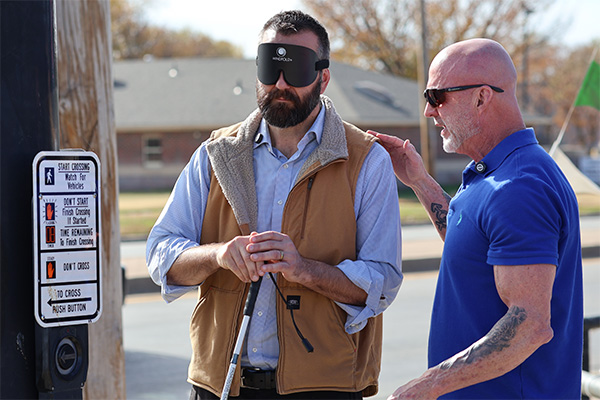
At the intersection of Pawnee and Broadway in Wichita, Kansas, Envision O&M Specialist Ray Oddis placed a long white cane into the hand of City of Wichita Traffic Engineer Mike Armour and handed him a blindfold.
Armour agreed to navigate several crossings the way a person with vision loss would: using a shoreline to stay aligned, locating the correct pedestrian signal, identifying the tactile “bump dots,” listening for the traffic surge and timing steps to avoid right-turn-on-red vehicles. At first, Oddis used human guide techniques and close coaching. By the final crossings, Armour was moving almost entirely on his own under blindfold, with Oddis offering only occasional cues and safety checks.
What followed was an experience that no diagram, code book or engineering manual could replicate. Armour felt how brick textures can pull travelers off-course, how noise masks traffic flow, how a single quiet vehicle can change the risk and how alignment can drift even when someone feels confident they’re walking straight.
Accessible pedestrian signals (APS), audible cues, consistent curb ramps and predictable crosswalk layouts are not conveniences, they are lifelines. Without them, people with vision loss face hazards that sighted pedestrians often don’t notice: misaligned crosswalks, quiet turning vehicles, inconsistent button placement, lack of tactile indicators and complex multi-lane crossings. These challenges don’t just make travel stressful; they can affect employment options, restrict mobility and reduce participation in community life. For someone with vision loss trying to get to work, school, a medical appointment or the grocery store, a single unsafe intersection can feel like a major barrier.
This is why the demonstration mattered. It turned a theoretical issue into something tangible, something urgent. Armour highlighted this during the walk-through. “We’ve got a lot of projects,” he said. “There are times when design has challenges, so hearing from you, and from people who work with the blind and visually impaired community, helps us understand what’s most crucial for us to strive for in our designs.”
This opportunity to have a voice with the Traffic Engineering Division reflects a broader commitment at Envision: to be present in rooms where decisions about infrastructure, safety, transportation and accessibility are made. It’s community engagement like this that makes daily life safer for everyone: children walking to school, seniors navigating medical appointments and adults with vision loss traveling independently to work and back home again.
As the demonstration wrapped, Oddis thanked Armour for his willingness to step into unfamiliar territory, and to listen.
“This is a good way for them to understand how much we appreciate their cooperation,” he said. “All I want to do is give you the right info, and I trust it’ll come out as good as it can be.”
That’s what Envision stands for, not just programs or services, but a voice in the room, helping shape a city where people with vision loss can move with freedom, safety and pride.