Abby Lautin finds purpose and community at Envision
By Envision Marketing • Jul 01, 2026
Blog Content
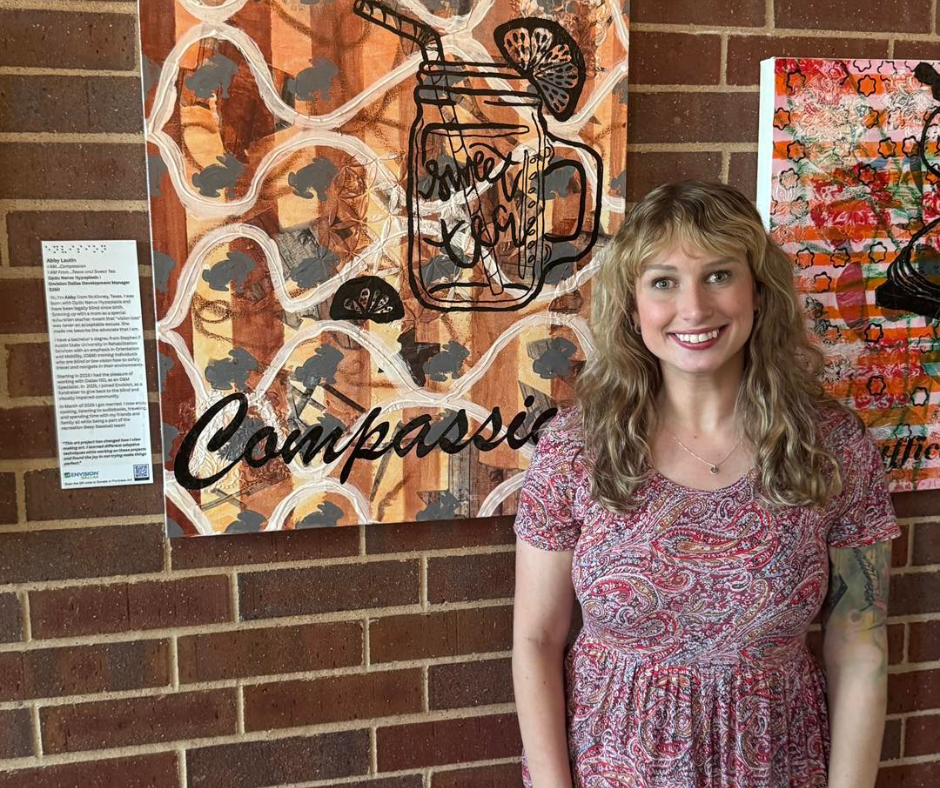
For Abby Lautin, the path to Envision started long before she joined the organization professionally.
Growing up with low vision in North Texas, she was already familiar with the blindness community through school programs and visits to what was then the Dallas Lighthouse for the Blind.
Born with optic nerve hypoplasia, an underdevelopment of the optic nerves, Lautin has lived with low vision her entire life. She also has nystagmus, a condition that causes involuntary eye movement.
“Growing up, I viewed organizations serving people who are blind or have low vision from the outside,” Lautin said. “Now, being part of Envision’s mission feels deeply personal.”
Today, Lautin works on Envision’s development team, helping build partnerships and connect donors to the organization’s mission. But her journey into employment and advocacy began as a teenager through a Texas Workforce Commission program designed to introduce students who are blind or have low vision to the workforce.
The five-week summer program partnered students with local businesses, helping them gain work experience while learning interview skills, workplace etiquette and problem-solving strategies.
“That was really my first encounter with employment,” Lautin said. “It was a way to dip your toes into the idea of what employment is.”
Through the program, Lautin landed her first job and later pursued a career as an orientation and mobility specialist with Dallas ISD. While working there, she toured Envision’s new Farmers Branch facility and connected with the development team.
“I was really interested in philanthropy work,” she said.
Although Envision was not hiring at the time, Lautin stayed persistent, continuing to reach out and look for opportunities to get involved.
“I kept reaching out because I knew it was the kind of work I wanted to do,” Lautin said. “Eventually, those conversations opened the door to an opportunity at Envision.”
Now at Envision, Lautin says one of the most meaningful parts of her experience has been finding a community where people understand the realities of living with vision loss.
She recalls attending her first art class at Envision and opening her white cane in a room full of people. Instead of confusion about the sound, someone immediately understood what she was doing. “It was such a small thing, but I remember thinking, ‘These people get it,’” Lautin said. “It felt like belonging.”
That sense of belonging extends throughout the organization, she said, from coworkers sharing resources and advice to the intentional design of Envision’s facility itself.
“There aren’t many places where you feel like things were designed for you,” Lautin said. “At Envision, everything was planned with people who are blind or have low vision in mind.”
She pointed to details throughout the Farmers Branch facility, including textured flooring near appliances, accessible navigation features and designated rideshare drop-off areas, as examples of how accessibility was considered from the beginning rather than added later.
“At Envision, it never feels like accessibility is an afterthought,” she said.
As part of the development team, Lautin now spends much of her time helping others understand the impact of Envision’s programs and services. She says the role has strengthened her confidence and communication skills, especially when connecting with new donors and community partners.
“You learn how to tailor the message to what matters most to people,” she said. “If someone is passionate about art, I highlight our art programs. If they care about children, I talk about our Child Development Center. It’s about finding what connects people to the mission.”
Lautin also hopes her story helps challenge misconceptions employers may have about hiring people who are blind or have low vision.
“I wish more employers understood that accommodations are often simple,” she said. “People who are blind or have low vision are often incredible problem solvers because we’ve spent our lives learning how to adapt.”
For Lautin, the work at Envision is about more than a paycheck. It is about creating opportunities for others to experience the same support and community she found herself.
“I feel like I’m making a difference in other people’s lives,” she said. “Someone’s life is going to be better because I went to work that day.”